Swiftraftix
Flow Series
Flow Series
Couldn't load pickup availability
- 🗂️ Digital file available after purchase
- ♾️ Long-term availability
- 🔐 Secure checkout
- 🗓️ Content updated in 2026
Self-paced learning overview
1. Problem Statement
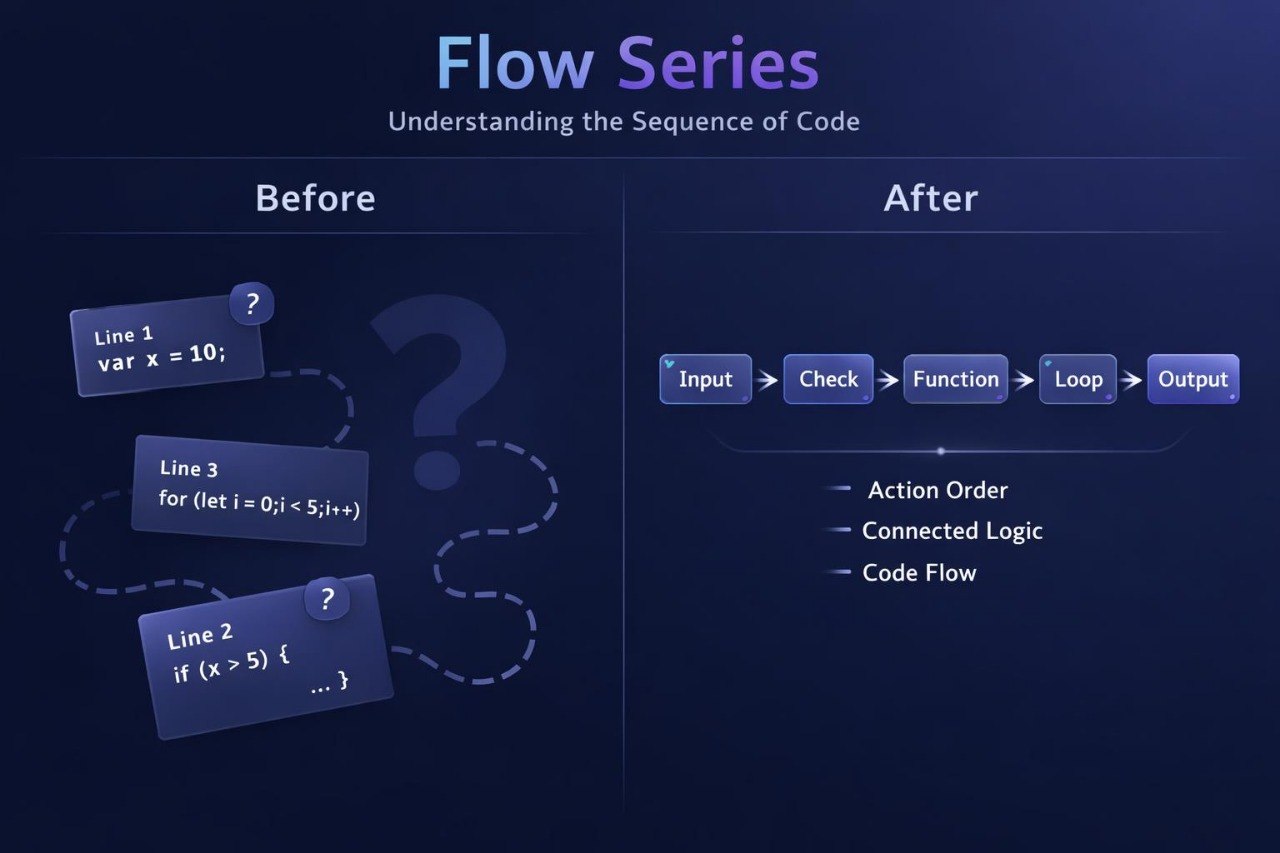
When code becomes longer, knowing separate Swift topics is no longer enough. It becomes important to understand how one action leads to another and how the result of a previous step affects the next one. Without that view, a learning example can feel confusing even when all separate parts are familiar. This becomes especially noticeable in tasks that include processing a data set, checking conditions, calling functions, and forming a final result. Flow Series was created to help learners see code as a sequence-based route rather than a set of disconnected commands.
2. Solution
Flow Series offers a learning route focused on the logic of code flow. The learner gradually reviews how data enters an example, how it changes, which checks it passes, and how the result is formed. The course connects variables, collections, conditions, functions, and repetition in more unified learning tasks. Each section includes an explanation, a step-by-step review of an example, and a practice task for independent work. This format helps learners read code more carefully, plan actions, and notice logical links between parts of an example.
3. What’s Inside
Flow Series includes materials for working with sequence, logic, and Swift code organization. The course begins with a short review of topics needed for later examples: variables, constants, data types, collections, conditions, functions, and repetition. The review is brief, but it prepares the learner for tasks where all these elements are used together.
The first section focuses on the flow of code execution. The learner reviews how Swift reads instructions from top to bottom, how line order affects the result, and why a small change in code position can change the behavior of the whole example. This block gives special attention to reading code as a story: what happened first, what happened next, and what result appeared at the end.
The second section explains the sequence of working with values. The learner sees how a value is created, stored, changed, passed into a function, and used in conditions. The materials show how to track the path of a value in code, which helps reduce confusion in larger learning examples.
The third section focuses on conditions in connected scenarios. Instead of separate checks, the learner works with examples where several conditions affect different parts of the logic. This helps explain how to build branching, how to read several possible paths, and how to avoid extra complication in learning code.
The fourth section focuses on repetition. The learner reviews how to apply one action to several elements, how to move through a collection, and how to gather a result after processing. The examples show how repetition helps work with data sets and reduce manual duplication in code.
The fifth section explains functions as parts of a learning route. The learner sees how a function can become a separate step in the overall logic: receive a value, process it, check a condition, or prepare a result. Special attention is given to how functions connect with each other and how one part of code can pass data to another.
The sixth section includes examples with several stages. The learner works with scenarios where a data set is created first, then checked, then processed through functions, and finally turned into a readable result. These examples help learners see how to plan code before writing it.
The seventh section is a practical learning project. In it, the learner creates a small scenario with data, conditions, repetition, and functions. The project is built to show the full path: from the starting idea to a completed learning example with tidy structure.
Flow Series also includes a self-review block. It contains questions that help evaluate your own example: where the logic begins, which data is used, where it changes, which conditions affect the result, and whether the structure can be made clearer.
4. Who Is This For?
Flow Series is for learners who already know the basic Swift topics and want to better understand how they work together in larger examples. If a learner has already worked with variables, conditions, functions, and collections, this course helps show the logical links between them.
The course is also suitable for learners who want to read code not only line by line, but as a sequence-based process. Flow Series is useful for those who want to understand why a certain action happens in one place rather than earlier or later.
This tier fits learners preparing for more detailed learning projects. It focuses on execution flow, action order, working with data, and building readable scenarios.
5. What You’ll Learn
- how to read Swift code as a sequence of actions;
- how to understand the order of instruction execution;
- how to track the path of a value in code;
- how to connect variables, conditions, functions, and collections;
- how to work with several logic steps;
- how to build branching in learning examples;
- how to use repetition for processing data sets;
- how to pass values between functions;
- how to divide a scenario into readable parts;
- how to plan code before writing;
- how to form a result after several processing stages;
- how to analyze your own learning example;
- how to reduce confusion in longer code;
- how to keep a tidy order in a Swift file.
6. Guarantee
- 30-day money back
- Risk-free
Are the courses suitable for learners who are just starting to study Swift?
Are the courses suitable for learners who are just starting to study Swift?
Yes, the materials are structured so that learners can move from basic concepts to more advanced topics at a calm pace. Each tier includes explanations, examples, and practical tasks that help learners develop skills gradually.
How are the tiers different from each other?
How are the tiers different from each other?
The tiers are arranged in ascending order by the amount of materials, number of topics, depth of explanations, and learning tasks. The beginner options introduce the basics, while the higher tiers include broader learning paths for working with code, logic, and learning projects.
Share